A Bowl of Words
There was always a bowl of words somewhere in the gallery.
Not always in the same place.
Sometimes it sat beside the guest book. Sometimes it greeted people near the front door. Other times I’d tuck it quietly into a corner and wait to see what happened.
I was curious.
I wanted to know how something as simple as a bowl of words could change the way people experienced a room.
Near the guest book, people would choose a word as they were leaving. They’d pause, read it aloud, compare it with a friend, and often stay a little longer. Conversations that had already begun found one more reason to continue.
Near the entrance, something different happened.
People would choose a word almost immediately and carry it with them as they wandered through the gallery. I loved watching someone stop in front of a painting and glance down at the card in their hand, as though the word had quietly become another way of looking at the work.
The artwork hadn’t changed.
The person looking at it had.
The bowl didn’t begin at a mano.
I’ve kept bowls of words, and sometimes inspirational quotes, in every studio I’ve worked in. My students knew them. Clients reached for them. Visitors always seemed drawn to them.
Sometimes the words became writing prompts. Sometimes they found their way into a collage or painting. More often than not, they became the beginning of a conversation.
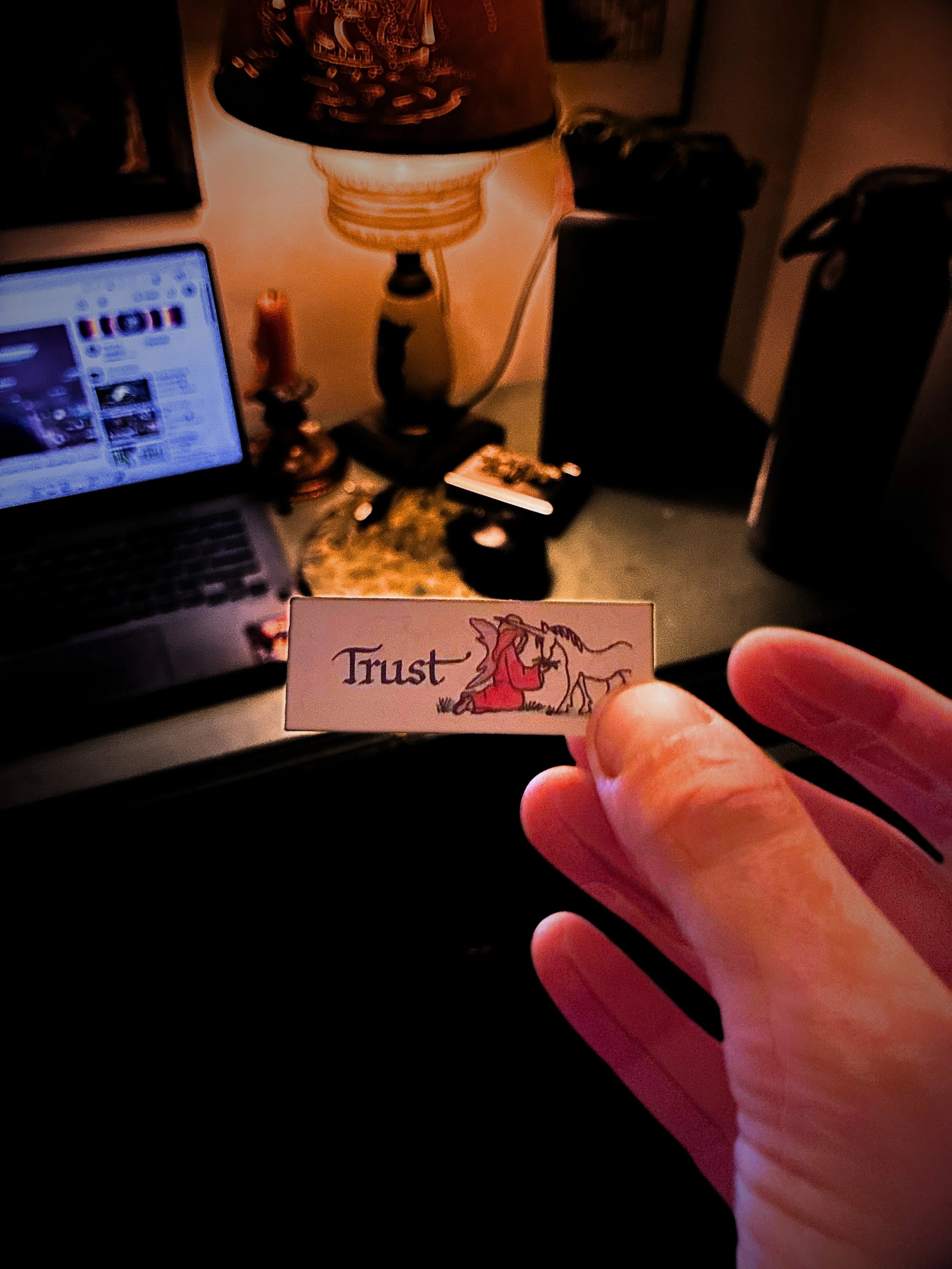
I’ve always loved the simplicity of a single word.
Hope.
Wonder.
Patience.
Compassion.
Courage.
One word asks very little of us.
It doesn’t tell us what to think.
It waits for us to bring our own meaning to it.
At Friday night’s Artist’s Table, I’d often scatter the cards across the table before everyone arrived. Every now and then, I’d hand someone the bowl and say, “Take a dip.”
I’d explain the idea of a Bible dip—opening to a page and trusting that whatever you found might somehow be the message you needed that day.
Whether someone believed it was divine intervention, coincidence, intuition, or something else entirely never mattered to me.
I liked the possibility that the right word might find its way into someone’s hand at the right moment.
It happened more often than you might think.
Someone would laugh.
Someone else would grow quiet.
Then, almost inevitably, they would begin telling the story of their day and why the word felt as though it belonged to them.
No one ever refused the bowl.
Not once.
When I packed up the gallery, I remember picking it up.
Of all the things I wrapped and boxed away, I wasn’t prepared for how emotional that moment would feel.
I remember thinking, They’re not going to travel.
I wasn’t thinking only about the cards. I was thinking about the intentions they carried—the invitation to pause, notice, and begin a conversation that might not otherwise have happened.
I imagined the bowl disappearing into a drawer, becoming one more object that belonged to a gallery that no longer existed.
Instead, it followed me home.
Today it sits on the coffee table in my studio, surrounded by all the things artists seem incapable of resisting: bones, old books, found objects, small treasures collected on walks, and doll hands waiting for a purpose.
Every time I walk into the room, I see it.
A few days after I published my first essay about closing the gallery, someone sent me a photograph of a word they had taken from a mano.
TRUST.
They still had it.
I smiled for a long time after that.
I had been wrong.
The cards had traveled in pockets and wallets, between the pages of books, and into people’s homes.
The intentions had traveled with them.
The bowl did travel.
Not all at once.
One word at a time.