The Shape of a Place
There was a ritual to opening the gallery.
I’d unlock the door and step into the quiet before anyone else arrived. Before I turned on a single light, before the music, before the day began, I’d light a bundle of sage.
The smoke drifted through the empty room, softening the sharp edges of morning. Then the lights came on, one by one. Music followed, always something gentle. By the time the front door was unlocked, the gallery had awakened. Sage and bamboo became the scent people associated with a mano. Long before they saw a painting or a sculpture, they had already stepped into an experience.
I cared about those things.
The gallery wasn’t simply a place to exhibit artwork. It was a space that invited people to slow down. The walls were a crisp white beneath fifteen-foot ceilings that gave the work room to breathe. Every light had been placed with intention, something I learned years earlier while dressing windows for Macy’s under a lighting architect who taught me that light tells people where to look and, just as importantly, how to feel.
The front window became my favorite place in the gallery. I curated it as carefully as any exhibition. A chair, a rug, artwork, all arranged to suggest a quiet moment rather than a storefront display. I wanted people walking by to imagine themselves there, to wonder what it might feel like to sit in that chair and look out onto Water Street.
Sometimes they’d notice the artwork first. Sometimes the chair. And sometimes, just before the light changed, they’d notice me sitting there. I’d smile to myself and wonder what story they had imagined was happening inside.
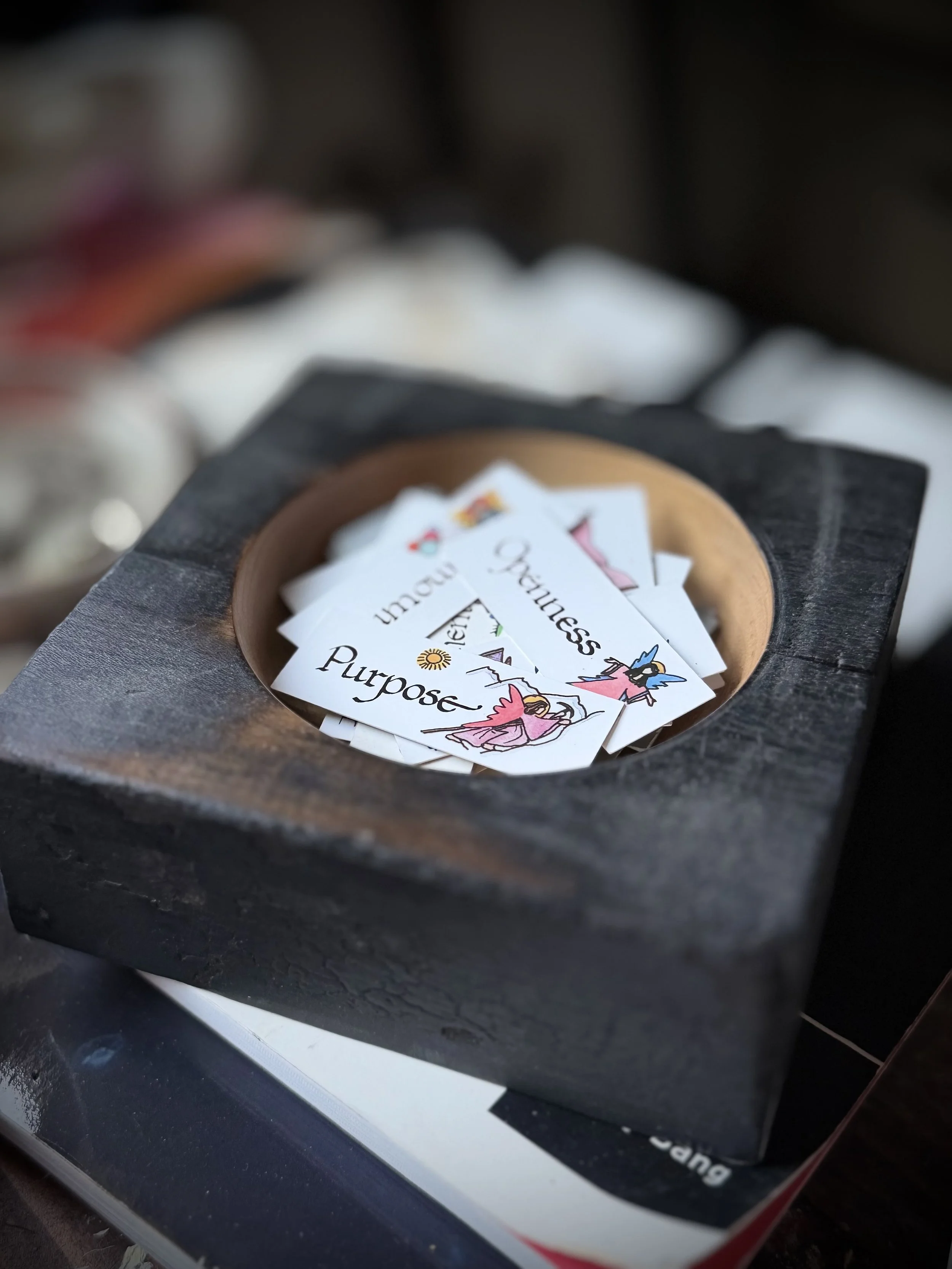
Somewhere in the gallery there was always a small bowl filled with words. I moved it often. Not because it belonged in one particular place, but because I enjoyed watching how people moved through the room when they discovered it somewhere new. It became a quiet little experiment in attention.
Inside were small cards, each printed with a single word.
Hope.
Wonder.
Compassion.
Patience.
People would turn them over in their hands. Sometimes they’d smile. Sometimes they’d compare them with a friend before slipping one into a pocket as they left. They weren’t souvenirs. They were invitations, another way of beginning a conversation. Upon closer inspection, I realize that’s what a mano was always trying to do; begin conversations.
When I first had the opportunity to open the space, I imagined something much smaller. My studio would be in the back, with a modest gallery and shop in the front. It felt like the perfect opportunity to stay connected to the artistic community that had welcomed me.
Then life changed.
At almost the exact same time I was offered the opportunity to open the space, my mother entered the final stages of a long illness. I made the decision to move an hour away to care for her.
Suddenly I had a choice. I could let the opportunity go, or I could imagine a different way for the space to exist. I had originally envisioned a studio in the back, with a small gallery and shop in the front. Instead, I leaned into the gallery. If I couldn’t be there every day making my own work, I could create a place where other artists could be seen. Looking back, I realize I wasn’t just opening a gallery. I was creating a tether back to the artistic community I loved, and to the part of myself I wasn’t ready to lose.
I wasn’t trying to build a traditional gallery. I was trying to build the kind of place I wished existed for artists like me, an artist’s gallery. I knew what it felt like to hand someone your work and hope they understood it. I knew the vulnerability that lived behind every exhibition. That shared understanding shaped everything about the way I curated. Artists weren’t simply hanging work on my walls. They were trusting me with something deeply personal. I never took that lightly.
Over the next three years, a mano hosted more than sixteen exhibitions. We collaborated with local organizations, Gilbert School, Torrington High School, musicians, writers, teachers, and community groups. Friday nights became The Artist’s Table, where people arrived as strangers carrying sketchbooks, half-finished ideas, or simply curiosity, and somehow left knowing one another. Connections and friendships were made at the table.
Those are the things that can be counted. What stays with me are the things that can’t. The retired accountant who finally gave himself permission to make art after decades of putting it aside. The artist visiting from France who wandered through the gallery by chance. The student standing just a little taller after seeing their work on a gallery wall for the first time. The collector who came in for one exhibition and quietly became part of the community. Almost everyone made a slow lap around the room before walking over to talk. We’d begin with the artwork. We almost never stayed there.
Art has a remarkable way of giving people permission to talk about themselves. A painting becomes a story about someone’s childhood. A sculpture reminds another person of a parent they’ve lost. Before long, we weren’t discussing composition or technique anymore. We were talking about memory, grief, hope, fear, love, or the strange ways our lives overlap without us realizing it.
Those conversations became my favorite part with visitors. People often thanked me for creating a welcoming gallery. The truth is, they created it. Every artist who trusted me with their work. Everyone who volunteered to paint walls or helped with clean up. Every teacher who brought students through the doors. Every visitor who decided to step inside instead of continuing down Water Street. Community isn’t something one person builds. It happens because people keep showing up for one another.
Someone told me that spaces like this aren’t a sustainable business model.
They were probably right. Financially, it never made much sense. But community rarely does.
Some of the most important things we build can’t be measured by a balance sheet.
Three weeks ago, I handed over the keys. The recent sale of the building brought a mano to an unexpected close. I found out just ten days before I had to move out. I’ve driven by since. The gallery sits exactly as I left it.
Empty.
Quiet.
Waiting.
It makes me sad, not because I miss owning a gallery, but because I know what happened inside those walls. I know the laughter they held, the risks artists took, friendships that began there and the thousands of conversations that slowly became a community.
Buildings change hands.
Businesses open and close.
That’s the nature of things.
But I don’t believe community disappears so easily.
It travels with the people who made it.
If a mano taught me anything, it’s that belonging isn’t created by four walls. It’s created every time someone chooses curiosity over assumption, conversation over silence, generosity over competition.
For three years, a little gallery on Water Street became a place where that happened again and again. What we built there was always larger than the room itself.
And for that, I will always be grateful.