What Remains
Matthew Feiner was the first artist I visited after closing the gallery, and the first I visited entirely for myself.
Before, my studio visits were written toward an exhibition. They became brief vignettes connecting the artist to a theme, small openings through which a viewer might enter the work. This time there was no show waiting on the other side of the conversation. I wanted to see the artist in the work. I wanted to notice where a life enters its materials, and what the materials remember once it does.
I was drawn to Matt because he is community-driven. He has built businesses, gathered people, placed signs in public, and kept showing up for New Haven. Community is not something he adds to his practice after the work is made. It is part of how the work comes into being.
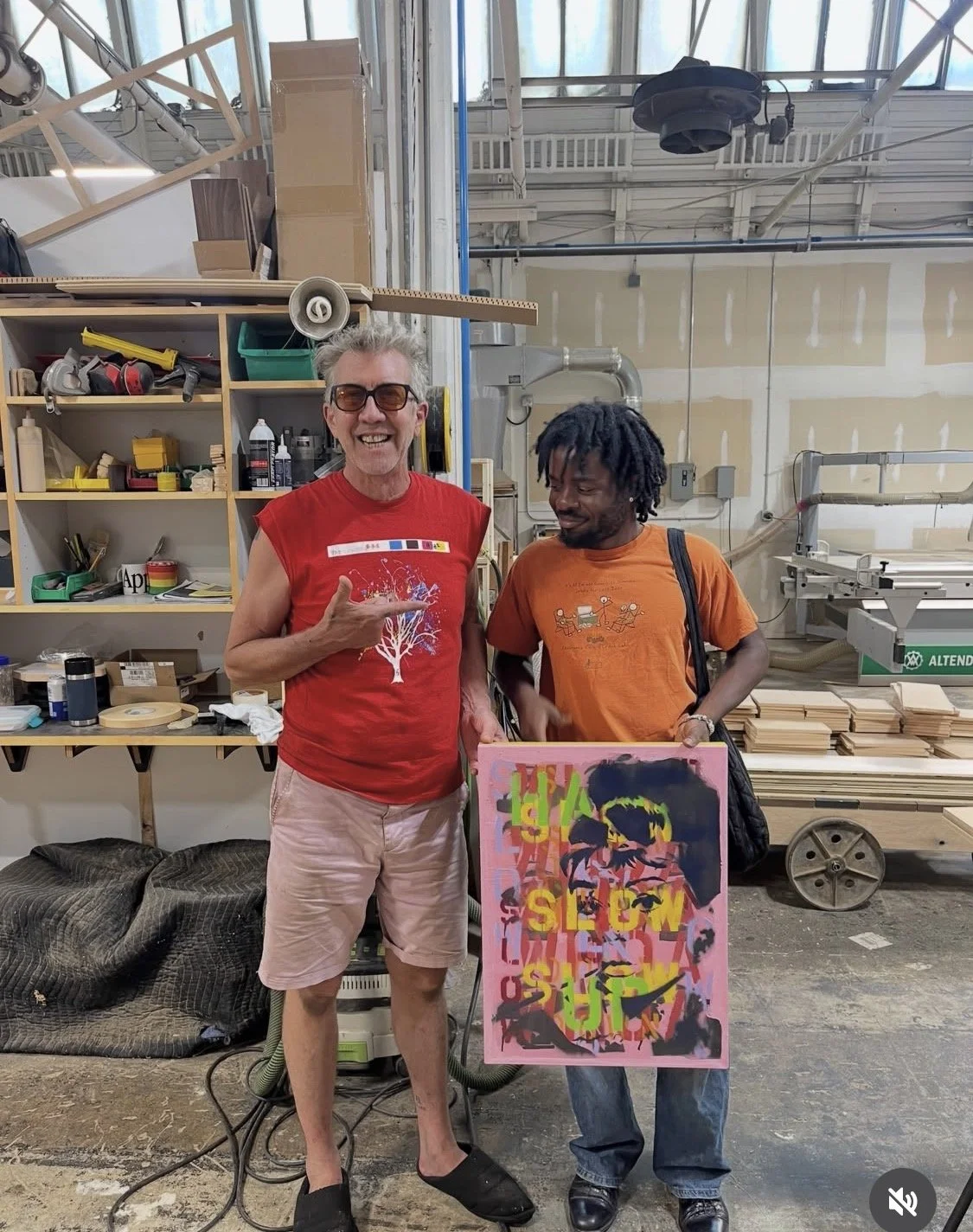
I understand that impulse. When I enter someone’s studio, I do not know how to remain outside the conversation and simply observe. I share. I recognize something from my own experience in theirs, offer it, and we riff from there. The recognition becomes a way into the work, but the work remains theirs.
When I entered Matt’s studio, the lights were low. Ceiling fans moved warm, humid air through the room. Matt wore sunglasses. Overhead blue light bothers his eyes, one of the changes that followed a bicycle accident and brain injury.
The studio did not reveal itself all at once. As my eyes adjusted, color emerged. Audrey Hepburn’s face appeared in different scales, repeating from floor to ceiling. SLOW DOWN signs were everywhere, some large, some small, some clear enough to read from across the room and others disappearing into layers. Old silkscreens served as a wall. Cardboard remnants from earlier work gathered in a pile on the floor. A unicycle hung overhead.
Along the back wall, shelves held older work sorted by project. Boxes were filled with newspaper clippings from Barbara’s house, including stories about Matt and his younger brother racing bicycles when they were young. The room was crowded but functional. Screens, clippings, scraps, signs, and unfinished work pressed close to one another. Everything seemed capable of returning as material.
Matt sat on a stool, as comfortably as he could, and shifted whenever discomfort made the position impossible. At one point, he rubbed an ache in his wrist. I recognized the movement before I consciously named it. Bodies in pain learn small acts of protection: rubbing, shifting, stretching, checking.
“I’m always recovering,” he said.
Recovery, as Matt described it, was not a completed period or a passage back to normal. It was an ongoing condition, changing from one day to the next. Matt and I have not had the same experience, but we recognized the labor of living in a body that interrupts, surprises, and requires constant negotiation.
Vision was part of that labor. Matt described losing depth perception, an image remaining after he had looked away, and moments when his right eye seemed to turn off while his brain supplied an image that did not match where his body actually was. I told him that when my own eyes become tired, the boundaries between colors can disappear. Tonal shifts become difficult to separate.
Between us, vision was not simply a metaphor. It was physical effort.
That made me look differently at Matt’s use of color. As a cyclist, he had learned what color could do in motion. Orange means caution. Neon yellow against black catches the eye. A flash of color moving beside a car can be startling, but startling can be the point. For a cyclist, visibility is survival.
“Pay attention to me,” Matt said.
In Matt’s work, color does not sit politely on the surface. It signals, warns, attracts, and sometimes overwhelms. It asks to be noticed because not being noticed has consequences.
One of the first works he showed me was about eight feet tall, built on a wooden frame. Everything rested on a Pepto-Bismol pink ground. Paper and cardboard stencils remained attached to the wood, so their seams, wrinkles, and edges became part of the surface. Matt painted over one generation, added more stencils, then painted again. Five or six versions occupied the same piece. Rows of black Audreys came into view, disappeared beneath later layers, and returned in fragments. SLOW DOWN surfaced between them in red, blue, and black.
Matt seemed excited to see what the work would become next. It was not unfinished because something was missing. It was alive because it could still absorb another experience.
This accumulation is central to his practice. His collages gather newspapers, photographs, cardboard, magazine images, text, and layer after layer of paint. Sometimes the earliest material remains visible. Sometimes it is completely buried. What came before is not necessarily gone. It has become pressure beneath the surface.
That way of working began in childhood. Matt grew up poor and was often sick. Barbara worked at a pharmacy and brought home expired magazines for him when he was sick. He tore them apart, rearranged their images, and covered the walls of his room. Audrey appeared on the covers and became part of the visual vocabulary he would carry for the rest of his life.
He made a world from those magazines. Long before collage became an artistic practice, Matt was learning to notice what was available, pull it apart, and give it another life.
The pink beneath the large work reminded me of Adam Alter’s book Drunk Tank Pink: And Other Unexpected Forces That Shape How We Think, Feel, and Behave. The title refers to a bubblegum pink once used in jail cells because it was believed to calm aggression. Visiting football locker rooms were painted the same color in the hope of weakening the opposing team.
His first new racing bike had been pink, and he joked that riders behind him might stare toward the center of the bicycle and become calm. He had a great season. “I don’t think it was the color of the bike,” he said.
Still, he liked the thought that the pink beneath the work might begin slowing someone down before the words could reach them.
Across the studio was a large square SLOW DOWN work. Audrey, painted in an eggplant purple, stood to one side against a pale blue field. The words were bright yellow. Unlike the tall pink work, where the sign had multiplied and collided with its earlier lives, this one still read clearly as an instruction.
Matt pointed to it and told me it had begun as a sticky note.
After the accident, anxiety and memory problems changed the way he moved through each day. His apartment had been covered in sticky notes reminding him of what he needed to know. I told him about an exercise my neurologist gave me after my stroke: write what I needed to remember in large, bold letters and place the notes on mirrors and windows. Looking at words on glass made my eyes move between the writing nearby and the space beyond it. That shift between near and far was meant to help my brain retain memory.
What I had been taught as a neurological exercise, Matt had arrived at through necessity. His sticky notes grew into larger sheets of paper and poster board, written in bold red and black Sharpie. He showed me lists of triggers, including specific scents. We agreed that Axe body spray is toxic. Then I began noticing more lists on the studio wall. They were not finished records. Matt revised them and added what he needed to know.
Some of the words locate him in time:
It is not 2016.
Obama is not president.
The studio is functional.
Functional means he can work there. The studio exists. He is in this version of the room, in this moment. Written large enough to meet him on the wall, the words offer evidence to a mind that needs to retrace its steps before it can arrive in the present.
How exhausting, I thought, to perform THAT much work simply to arrive where everyone assumes you already are.
The lists are not separate from Matt’s collage practice. They are one of its recurring layers. From the moment he enters the day, he is reading, remembering, revising, checking pain, checking time, checking what his body can do, and orienting himself to now. Of course that repetition enters the work! The lists hold additions and corrections. The paintings do too.
What is now encountered publicly as a road sign began privately as an accommodation.
“It was for me at first,” Matt said.
“I want it to be a road sign right now. I don’t think it’s played out its time as a road sign yet.”
The words moved outward without leaving their original need behind. SLOW DOWN could become a warning for a driver, a request from a cyclist, or an invitation to someone whose body and mind require more time. The sign carries all of those meanings because it has carried Matt through time.
“Slow down and connect with yourself and with your body,” he said.
“When I found cycling, I found my body.”
Cycling had given Matt a way into his body. After the accident, that same body required new forms of attention. SLOW DOWN seemed to hold both truths: the body found through movement and the body that must be found again.
Finding his body through cycling also led Matt into community. He returned to New Haven intending to make art. “I moved back here just to be an artist,” he told me. “After two years and blowing my savings, I opened the bike shop.”
The Devil’s Gear Bike Shop became a business, a gathering place, and an expression of his belief in bicycles, public life, and New Haven. His art, cycling, and community work did not develop as separate identities. They grew through one another.
“Nothing happens in community without people doing it,” he said.
Community is often discussed as if it already exists, as a location, an audience, or a quality a place simply has. Matt spoke about it as labor. People call, organize, introduce, open doors, attend, support, and return after the excitement of beginning has passed.
“We just keep showing up.”
The words could hold art, recovery, and community at once.
“The community part is so important for your own, not just success, but for your own wellbeing,” Matt said.
Our shared need for community sat beside a quieter recognition between us. We both knew something about the work required to stay present in a changing body. Community can hold a person when individual capacity changes, but only if people keep making it. It is both refuge and responsibility.
“You have to make your own place,” Matt said.
He has done this literally and repeatedly. A bike shop becomes a gathering place. A private reminder becomes a public sign. A studio becomes a working archive. Even while caring for Barbara in Florida, when his time and movement were constrained, he found a place to make.
He was caring for her around the clock and could not go anywhere, so he went out to the metal shed behind her home. It held twenty-five years of lawn equipment, old tools, and the remnants of other people’s projects. Matt was supposed to empty it. Instead, he began noticing patterns among the objects. By the time he was finished, he had made twenty-five sculptures and called the project The Shed.
“It’s how we deal,” he said.
Caring for his mother and making art occupied the same space. Again, what was available became material. Again, a project became a tether to the part of himself that needed to remain present.
Matt also showed me a scale model. Looking down into it, I saw a miniature room with walls covered in newspapers. It belonged to a full-room installation imagining the creative life Barbara might have lived. She once said, “Maybe I wanted to take a pottery class.” The installation gave that unlived life a room.
But the room was not the only homage. Looking from those miniature newspaper walls back to the studio, I began to feel that Barbara was present in the materials themselves. The magazines she brought to a sick child had become Audrey, collage, and a lifelong way of making from what was at hand. The clippings she saved had returned as an archive. Matt had carried what she gave him through the work for the rest of his life.
The evolution in Matt’s work is not a movement away from the sign. It is what happens when the sign is made to carry time. The clear square work began as a sticky note. In the large pink work, Audrey and SLOW DOWN repeat until different moments collide. Earlier marks disappear beneath later ones, then surface again.
The sign carries time in the same way Matt’s lists do. Both are revised as his understanding changes. Matt carries time through lists. The work carries it materially.
Facing the pink work across the studio was another large piece, close to seven feet tall. Green hospital tiles repeated so insistently that they first appeared to be a pattern. Yellow lines moved across the tiled field. Unlike the pink work, this surface had no words yet. Matt told me he had forgotten to add a text layer and would return to it.
When I asked where the tile image came from, he began telling me about an experience his body held before he was old enough to give it language. As an infant, an act of violence left him hospitalized, first in traction and then in a body cast. Somewhere inside that experience, the green tiles remained.
Years later, after the bicycle accident, the memory returned through a nightmare, the loss of his arm inside it, and the feeling of being casted again. He awoke with his injured arm pulled behind him, numb and unresponsive.
The past returned not only as an image, but as position, numbness, fear, and pain.
Standing in front of the green work, Matt opened a large Moleskine across two facing pages. The pages were dense with lists of pain, neurological tests, accidents, physical sensations, and memories of hospitalization. These were the words he intended to bring into the painting’s missing layer.
The lists were entering the painting.
Experiences that did not arrive as a coherent story could occupy one surface without being forced into a clean chronology. With the notebook open between us, we talked about phantom pain and the ways a body remembers. Memory does not always return in sentences. It can arrive as an image, a scent, a posture, or an ache that seems to know something before the conscious mind does.
“Your pain is your worst possible pain,” Matt said. “You can’t compare it to my worst possible pain. At the same time, it’s all the same. Pain is pain.”
From where we stood, the pink and green works were literally facing one another. The pink field was crowded with words and faces, reminders repeated until they carried their own history. Across from it, the green tiles held an image the body had never forgotten and waited for the lists that would become their next layer.
Between them was a studio filled with evidence of how Matt works: the expired magazine becomes Audrey; the sticky note becomes a road sign; the wall list becomes a painting layer; the hospital tile becomes a field of memory; the cyclist’s color becomes a demand to be seen; the contents of a shed become twenty-five sculptures; the bike shop becomes community.
Nothing is transformed by forgetting what it was.
Barbara brought a sick child magazines, and Matt made a world from them. He has continued making places from available materials, a changing body, an injured mind, complicated histories, and the people willing to gather around him.
This was why he was the first artist I wanted to visit after closing the gallery. I had left the structure through which I had been accustomed to building community, but I had not left the need for it. I was looking differently now, without an exhibition to explain, for the places where life shows up in the work.
Matt’s studio made that visible. Life does not enter the work once. It returns through materials, gestures, lists, colors, and revisions. What matters is not preserved untouched. It is handled again.
We make a place. We revise it. We add what we now know. We return to what remains.
Slow down. Allow the eyes to adjust. Notice what is still visible beneath the surface. Pay attention to the person sharing the road.
Then keep showing up.
Matt’s studio is one of many located in The Gilbert Street Building in West Haven, CT. Learn more about Matt on his IG: https://www.instagram.com/matthew_j_feiner/